

Buying your first home is exciting, and a little overwhelming. Between reservation fees, financing options, titles, taxes, and a long list of documents, it is easy to feel lost. After years of helping Filipino families, OFWs, and foreign buyers find property here in Cebu and across the Philippines, I have seen the same questions come up again and again.
Buying a home involves more than choosing a property you like. You need to understand your budget, financing options, required documents, additional expenses, and the steps involved in completing a purchase.
If you’re planning to buy your first home in the Philippines, this guide will walk you through the process, from assessing your finances to choosing a property and preparing for move-in day.
This guide is for Filipinos buying their first home, whether they live and work in the Philippines or overseas as OFWs. It covers property costs, financing options, requirements, and practical tips to help you make informed decisions.
- 1. What Type of Property Should You Buy?
- 2. Understand the Total Cost of Buying
- 3. Pre-Selling vs. Ready-for-Occupancy Properties
- 4. How to Determine Your Homebuying Budget
- 5. The Step-by-Step Homebuying Process
- 6. Common Mistakes First-Time Homebuyers Should Avoid
- 7. Frequently Asked Questions About Buying Your First Home in the Philippines
- 8. Find Your First Home with YourHome.ph
1. What Type of Property Should You Buy?
The right property depends on your lifestyle, financial capacity, family needs, and long-term plans.
Condominium

A condominium is an option for buyers who prefer living near business districts, commercial establishments, and major transportation routes.
Benefits include:
- Convenient access to workplaces and commercial areas.
- Shared amenities such as swimming pools, gyms, and function rooms, depending on the development.
- Potential rental demand in suitable locations.
- Less responsibility for maintaining the entire building and surrounding grounds.
However, condominiums may involve monthly association dues, parking expenses, and restrictions imposed by the condominium corporation.
A condo may suit young professionals, couples, small families, and buyers who prioritize convenience.
House and Lot

A house and lot gives you a residential structure together with ownership of the underlying land, subject to the applicable title and property arrangements.
Potential benefits include:
- More privacy and living space.
- Outdoor areas for children, pets, or gardening.
- Greater flexibility in how you use your home, subject to applicable restrictions.
- Potential long-term land value appreciation.
However, house-and-lot properties may require more maintenance. Buyers should also consider their distance from work, schools, hospitals, and other essential destinations.
Townhouse

A townhouse offers a middle ground between condominium living and a detached house.
It may provide multiple floors, private living spaces, and a small outdoor area. However, buyers should check parking availability, floor area, shared walls, subdivision rules, and any applicable association dues.
Residential Lot

Buying a residential lot allows you to plan and construct a house according to your needs, budget, and design preferences.
However, you must account for construction costs, permits, utility connections, site development, and professional fees.
Before purchasing, verify the title, boundaries, access roads, land classification, zoning, and applicable development restrictions.
Which should you choose?
If you prioritize convenience and proximity to business districts, consider a condominium.
If you need more space for your family, compare house-and-lot properties.
If you want to build a customized home, a residential lot may be worth exploring.
Your decision should be based on both your current needs and your long-term financial capacity.
2. Understand the Total Cost of Buying
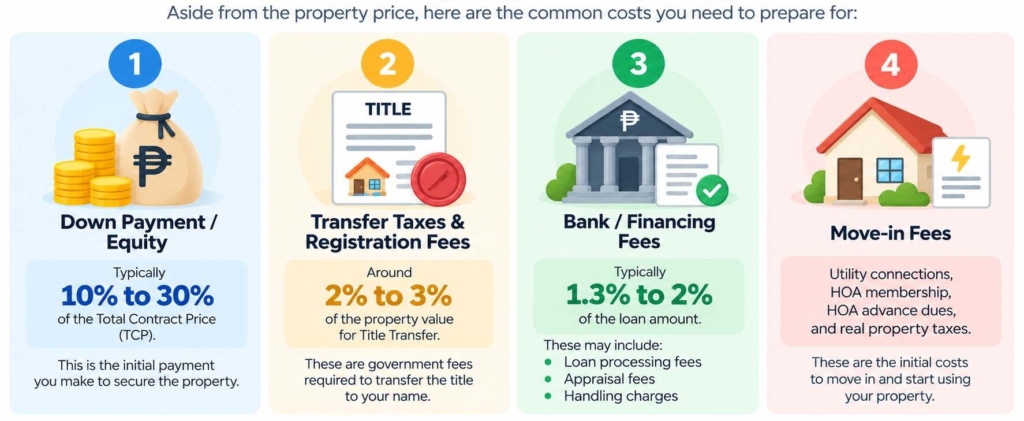
The selling price listed by a developer or seller is rarely the final amount you will pay. Always factor in extra transactional and closing costs:
Down Payment / Equity
- Typically 10%–30% of the Total Contract Price (TCP), depending on the developer’s payment terms, bank financing approval and property appraisal.
- Banks may finance up to 90% of the appraised property value, meaning buyers should generally prepare at least 20% equity when the appraisal matches the purchase price.
- Some developers offer lower initial equity requirements or installment payment schemes, particularly for pre-selling properties.
Transfer Taxes & Registration Fees
- Budget approximately 2%–3% of the property value as an initial allowance, subject to the actual LGU and Registry of Deeds assessment.
- Includes:
- Documentary Stamp Tax (Deed of Sale): 1.5%.
- Local Transfer Tax: commonly 0.5%–0.75%.
- Registry of Deeds registration fees: variable based on the applicable schedule.
- Notarial and administrative charges: variable.
- For developer purchases, miscellaneous charges may be collected according to the developer’s contract and itemized computation.
Bank / Financing Fees
- May include:
- Loan appraisal fee.
- Processing or handling fee.
- Loan Documentary Stamp Tax.
- Mortgage registration fee.
- Credit Life Insurance (CLI).
- Fire Insurance.
- Notarial and documentation fees.
- Actual charges depend on the bank, approved loan amount, borrower profile, property and applicable promotions.
Move-in Fees & Pre-turnover Expenses
- Budget separately for:
- Electricity and water connection fees or deposits.
- HOA or condominium membership fees.
- Advance association dues.
- Move-in and administrative fees.
- Prorated Real Property Tax (RPT), when applicable.
- Internet installation and other utility expenses.
Recurring Ownership Expenses
Remember to include recurring costs such as:
- Real property tax.
- Condominium association dues or subdivision fees, where applicable.
- Insurance.
- Utilities.
- Repairs and maintenance.
These expenses continue after you move in.
Important: Always request an itemized statement of charges from the developer, bank and relevant government offices.
3. Pre-Selling vs. Ready-for-Occupancy Properties
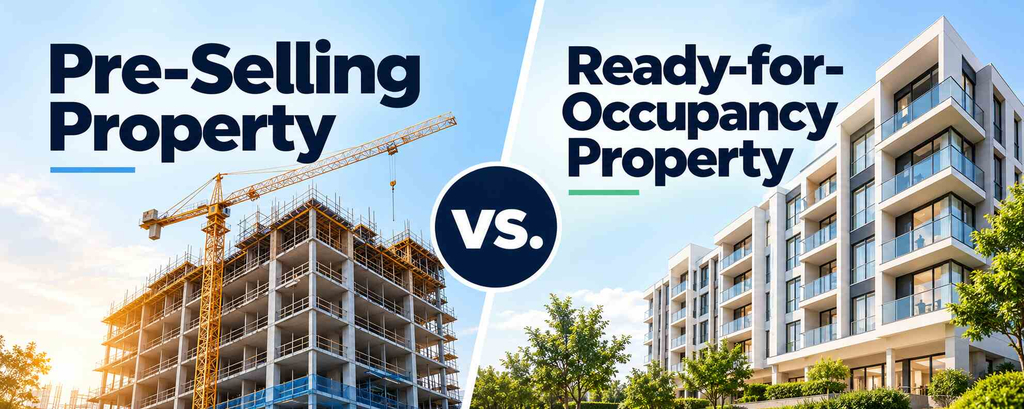
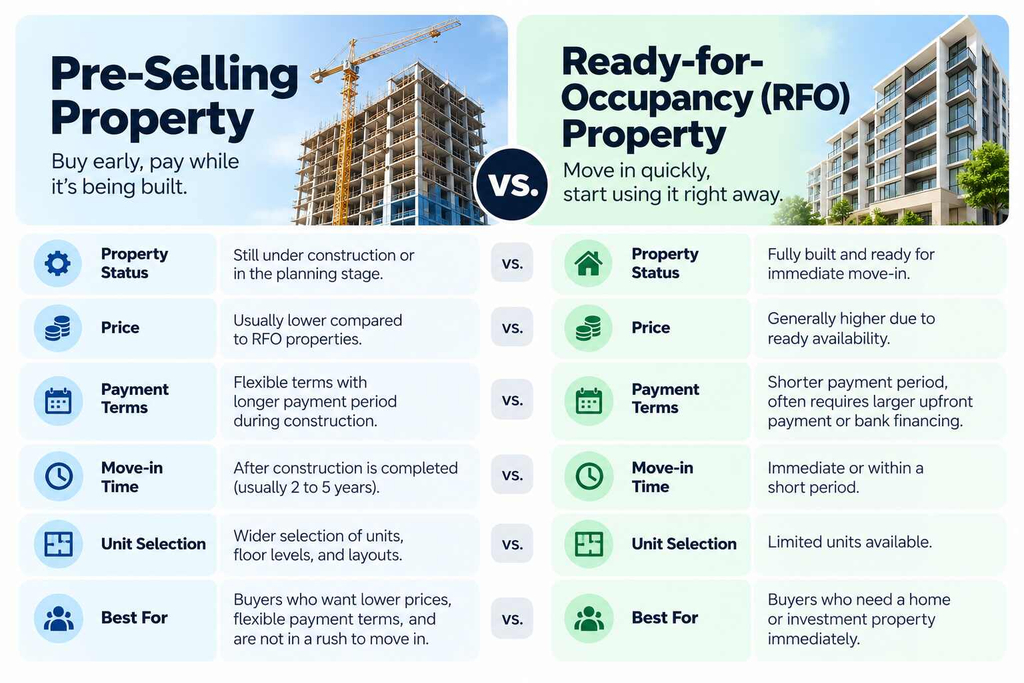
One of the most important decisions first-time buyers make is whether to purchase a pre-selling property or a ready-for-occupancy property.
What Is a Pre-Selling Property?
A pre-selling property is sold before the development or unit is completed.
Depending on the project, buyers may be able to spread their equity payments over an extended period.
Potential advantages include:
- More time to prepare financially.
- Access to units during the project’s early sales stages.
- A wider selection of available units in some developments.
- Potential price differences compared with completed properties.
However, pre-selling properties involve waiting for construction and turnover.
Buyers should investigate the developer’s track record, project status, expected completion date, applicable permits, and contractual provisions covering delays or cancellation.
Do not assume that every pre-selling property will appreciate in value or generate rental income.
What Is a Ready-for-Occupancy Property?
A ready-for-occupancy (RFO) property is completed and available for occupancy, subject to the required turnover and documentation arrangements.
Potential advantages include:
- The ability to inspect the actual unit or house.
- A clearer view of the surrounding neighborhood.
- The possibility of moving in sooner.
- The possibility of generating rental income sooner, if the property is suitable and all relevant conditions are met.
However, RFO properties may require a larger initial cash outlay or faster payment of the required equity, depending on the seller’s terms.
Location & Accessibility
Location remains the primary driver of property value and lifestyle convenience. Consider:
- Proximity to work, reputable schools, medical facilities, and commercial hubs.
- Flood vulnerability, geological safety, and local infrastructure developments (e.g., transit lines, expressways).
- Property management track record and neighborhood security.
4. How to Determine Your Homebuying Budget
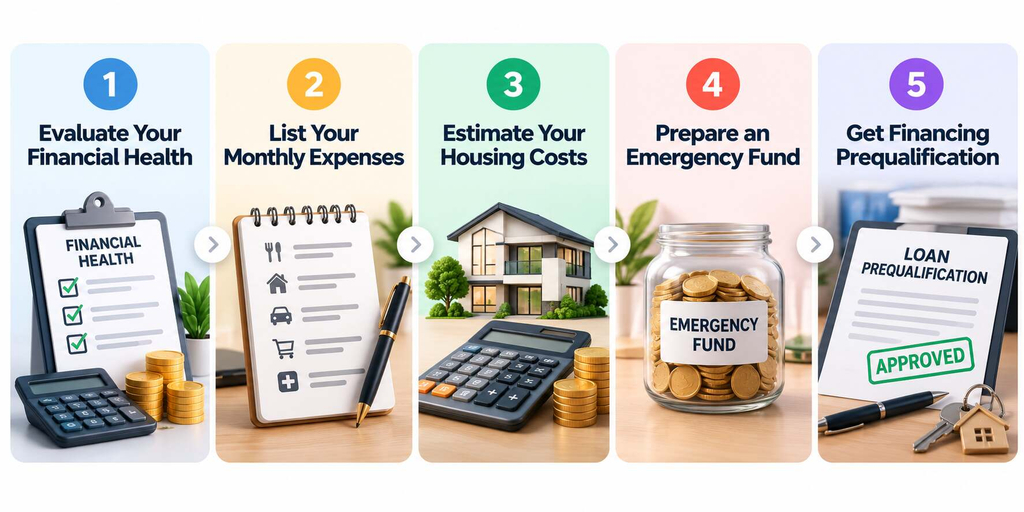
A property may be attractive, but that does not mean it fits your financial situation.
Before choosing a property, calculate how much you can comfortably allocate to housing.
Step 1: Evaluate Your Financial Health
Before browsing listings or visiting showroom model units, take a realistic look at your finances:
- Total Savings: Ensure you have enough for the total down payment (equity), processing fees, move-in fees, and an emergency buffer fund.
- Monthly Income & Debt Ratio: Financial institutions generally require that your monthly amortization does not exceed 30% to 35% of your gross monthly income.
- Credit Profile: Pay off existing consumer credit card debts or personal loans to boost your creditworthiness for loan approval.
Start with your regular take-home income.
If you’re employed, review your net salary after deductions.
If you’re self-employed or operating a business, examine your documented income, business expenses, taxes, and actual cash flow. Do not rely solely on your highest-earning months.
Step 2: List Your Monthly Expenses
Include expenses such as:
- Food and groceries.
- Transportation and fuel.
- Utilities and internet.
- Insurance and medical expenses.
- Family support.
- Existing loan and credit card payments.
- Savings and emergency funds.
The amount remaining after these expenses helps determine what you can reasonably allocate to housing.
Step 3: Estimate Your Housing Costs
Consider the full monthly cost, not just the loan amortization.
For a condominium, include association dues and parking expenses where applicable. For a house, include maintenance, utilities, and any relevant subdivision dues.
Step 4: Prepare an Emergency Fund
Avoid using all your available cash for the down payment.
Homeownership comes with unexpected expenses, including repairs, medical emergencies, and changes in income.
Maintaining accessible savings can help you avoid relying on expensive debt when unexpected costs arise.
Step 5: Get Financing Prequalification
Contact Pag-IBIG or a bank to understand your potential loan eligibility.
A preliminary assessment can help you establish a realistic property budget, but it is not the same as final loan approval.
A good rule: Choose a property that allows you to maintain your financial stability, not one that leaves you struggling to cover everyday expenses.
5. The Step-by-Step Homebuying Process
Step 1: Reservation & Documentation
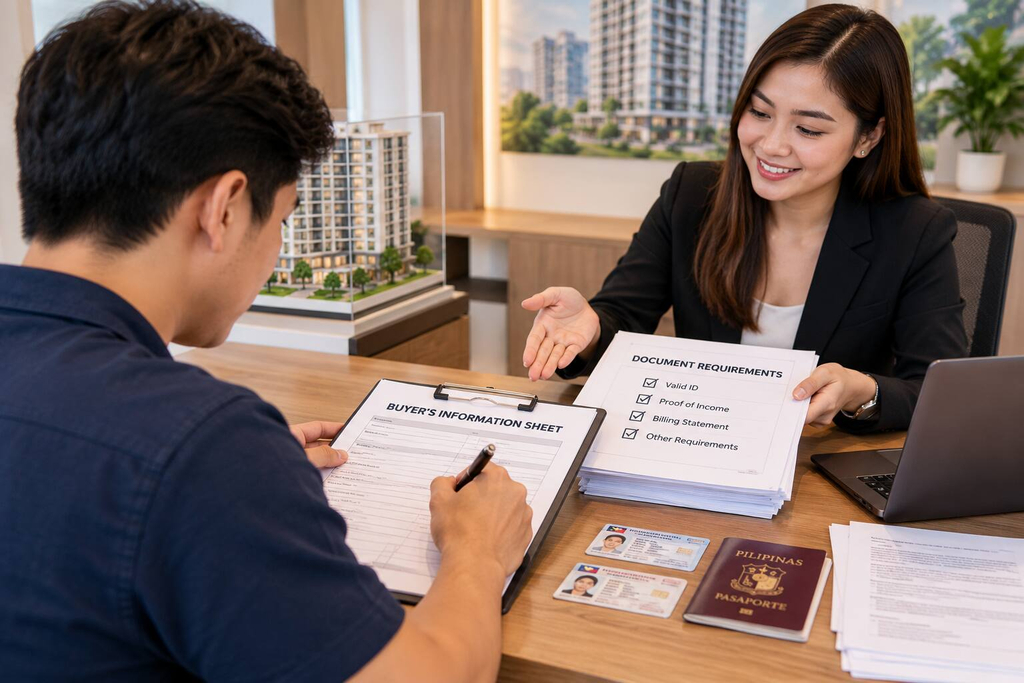
- Choose your specific unit/lot and complete the Reservation Agreement.
- Pay the Reservation Fee (this locks in the unit price and deducts from the total equity).
- Submit initial Know-Your-Customer (KYC) documents:
- Government-issued IDs (Driver’s License, Passport, UMID)
- Proof of Income (Payslips, ITR, Certificate of Employment)
- Marriage Certificate / Birth Certificate
- TIN (Tax Identification Number)
Step 2: Equity / Down Payment Phase

- Pay the agreed monthly equity over the specified payment schedule.
- Review and sign the Contract to Sell (CTS) provided by the developer.
Step 3: Securing Financing (Bank vs. Pag-IBIG vs In-House)
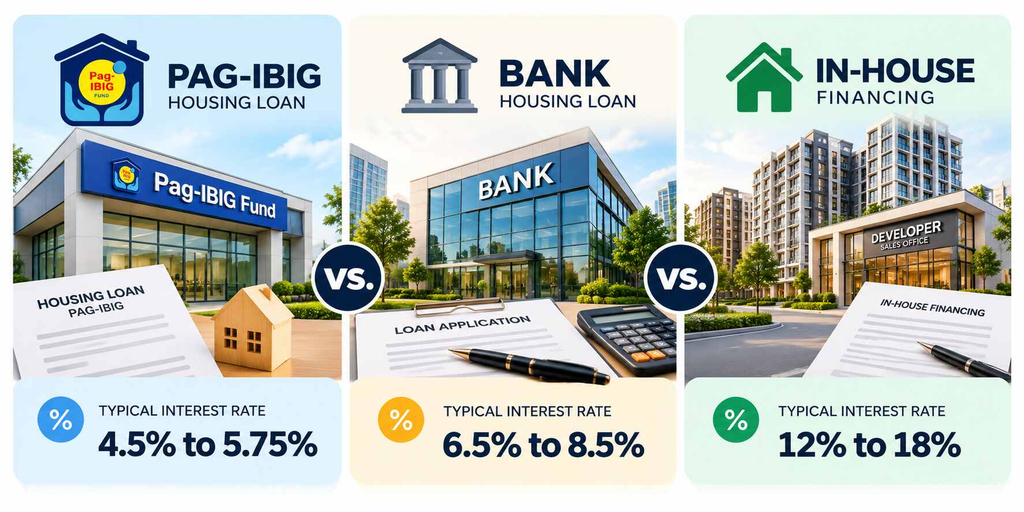
Prior to completing the equity period (usually 3–6 months before loan drawdown), apply for long-term financing for the remaining balance (80% to 90% of TCP).
Pag-IBIG Fund (HDMF):
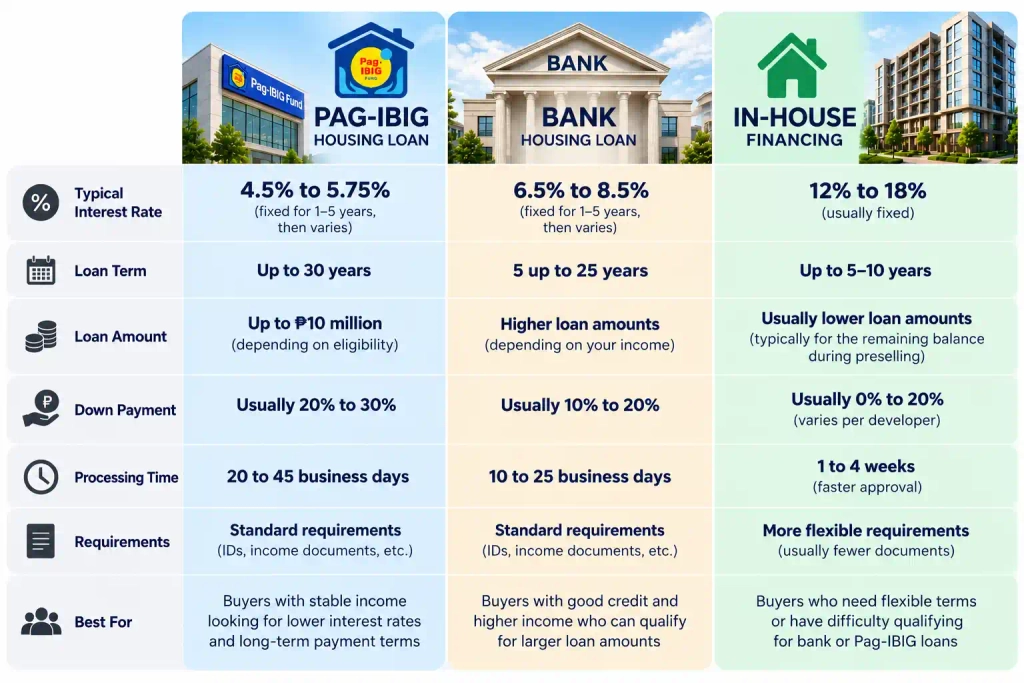
- Offers fixed interest rates starting at 4.5% to 5.75% for initial fixing periods (with standard rates between 5.875% and 9.75% depending on term length).
- Maximum loan term of up to 30 years.
- Maximum loan amount is now up to ₱10 Million (increased from the previous ₱6M limit).
- Requires active contribution records and basic proof of income.
Bank Financing
- Shorter maximum terms (usually 15 to 20 years).
- Competitive interest rates typically ranging between 6.5% and 8.5%, subject to repricing terms (1, 2, 3, or 5 years).
- Strict income eligibility and financial documentation requirements.
In-House Financing:
- Direct loan provided by the property developer, typically for shorter terms (5 to 10 years).
- High interest rates ranging from 12% to 18% per annum.
- Minimal document requirements and fast, guaranteed approval without bank or Pag-IBIG background checks.
- Common Strategy: Used as a temporary bridge option while waiting for bank approval or fixing documentation.
Step 4: Loan Takeout & Deed of Absolute Sale
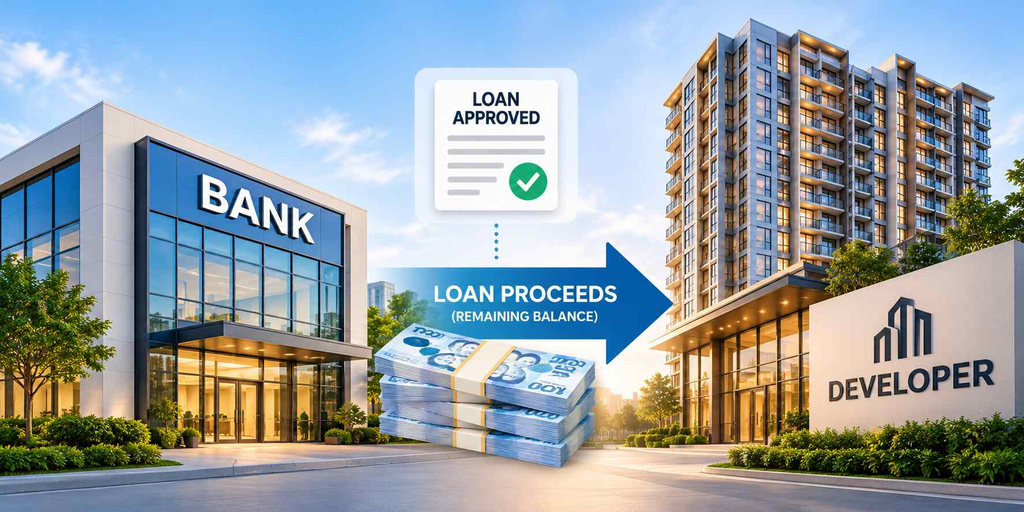
- Upon loan approval, the bank or Pag-IBIG pays the remaining balance directly to the developer (Loan Takeout).
- The developer issues the Deed of Absolute Sale (DOAS).
Step 5: Turnover & Move-In
- Conduct a thorough Punch-Listing Inspection before signing turnover acceptance documents. Check tile work, wall finishes, plumbing fixtures, electrical outlets, and door alignments.
- Pay turnover and utility connection fees.
- Receive keys, unit turnover, and condominium/homeowner guidelines.

6. Common Mistakes First-Time Homebuyers Should Avoid
Buying your first home can be exciting, but rushing into a decision can create financial and legal problems.
Avoid these common mistakes.
Shopping Before Getting Pre-Approved
It is easy to fall in love with online property tours, model units, or open houses before knowing what a bank or lending institution will actually lend you.
The Risk
If you sign a reservation agreement or make an offer before getting pre-approved, you risk making a non-refundable deposit on a home you cannot finance. If the bank appraises the property lower than the purchase price or determines that your gross income falls short of their debt-to-income limits, you will be forced to cover the funding gap out-of-pocket or forfeit your deposit.
The Solution
Get a formal Pre-Approval Letter from a bank or Pag-IBIG Fund (HDMF) before looking at properties. Knowing your clear maximum loan capacity allows you to narrow down your property search to realistic price points.
Not Checking the Developer’s Credentials and Project License to Sell
First-time homebuyers sometimes focus too much on the property’s design, location, amenities, and payment terms without checking whether the developer and project have the necessary credentials and government approvals.
The Risk
Buying from an unverified developer or a project without the required License to Sell (LTS) can expose you to construction delays, incomplete developments, contractual disputes, or financial losses.
A developer’s attractive marketing materials and model units do not automatically guarantee that the project is properly registered or authorized for sale.
The Solution
Before making a reservation or signing a contract:
- Verify the Developer: Research the developer’s track record, completed projects, financial standing, and reputation.
- Check the License to Sell: Verify that the specific condominium or subdivision project has a valid License to Sell issued by the Department of Human Settlements and Urban Development (DHSUD).
- Check Project Registration: Confirm that the project has the required Certificate of Registration (CR) and other applicable government approvals.
- Visit Completed Projects: Whenever possible, inspect the developer’s previous developments to assess construction quality, property management, and actual turnover performance.
- Review the Documents: Ask for copies of relevant permits, project approvals, and sales documentation before committing financially.
Remember: A reputable developer and a properly licensed project provide an important layer of protection for your investment.
Not Comparing Prices and Offers
Focusing on a single project or location without checking comparable options in the immediate area often leads to overpaying.
The Risk
Developers and individual seller listings vary widely in price per square meter, amenity packages, and turn-over schedules. Without comparative market analysis (CMA), you may buy a property with lower long-term appreciation potential or higher hidden turnover charges.
The Solution
- Compare at least 3 to 5 properties in the same sub-market or neighboring district.
- Evaluate price per square meter, developer track record, accessibility to public transit, and planned infrastructure developments in the area.
Overlooking the Pre-Approval Process
Some buyers assume that getting pre-approved is an automated step or mistake a preliminary pre-qualification calculation for an actual pre-approval.
The Risk
Pre-qualification is an informal estimate based on self-reported income. Pre-approval requires submitting complete documentation—including Income Tax Returns (ITR), Certificate of Employment (COE), payslips, and audited financial statements. Missing documents, unreported debts, or temporary employment status can stall or decline your application mid-transaction.
The Solution
Treat the pre-approval process seriously from day one:
- Organize your financial documents early (ITR, payslips, bank statements).
- Clear small existing loans or credit card balances to improve your credit standing.
- Avoid taking on new debt or switching jobs right before or during your mortgage application.
Getting Only One Mortgage Quote
Many buyers go straight to their primary payroll bank or accept the default financing option offered by the developer without shopping around.
The Risk
Interest rates, fixed-rate period terms (1, 3, 5, or 10 years), appraisal charges, and processing fees vary significantly across financial institutions. Accepting the first offer without comparison can cost you significantly over a 15- to 30-year loan term.
The Solution
Request written loan disclosures from at least three different lenders (e.g., major commercial banks and Pag-IBIG Fund). Compare:
- Initial Interest Rates & Repricing Schedules (e.g., 6.5% fixed for 3 years vs. 7.0% fixed for 5 years).
- Bank Processing Charges & Fees (typically 1.3% to 2.0% of the total loan amount).
- Loan-to-Value (LTV) Ratios offered for the property.
Not Inspecting the Property
Skipping a detailed property inspection—whether buying a newly turned-over pre-selling unit or an existing secondary-market home—is a critical mistake.
The Risk
Hidden structural flaws, leaking plumbing, improper electrical wiring, hollow tiles, or water seepage during heavy rains can cost hundreds of thousands of pesos in repairs right after turnover.
The Solution
- For Pre-Selling/New Construction: Do not sign the turnover acceptance form until you have conducted a thorough punch-list inspection. Require the developer to rectify all noted defects before accepting the keys.
- For Resale Properties: Hire a professional property inspector or licensed contractor to evaluate the roof, plumbing, load-bearing walls, and electrical lines before closing the sale.
Not Working with a Real Estate Broker
Attempting to navigate real estate contracts, title verifications, bank documentation, and developer Negotiations entirely on your own increases exposure to legal and financial risks.
The Risk
Missing hidden clauses in contracts, failing to verify the legal status of a property title at the Registry of Deeds (RD), or buying a project without a valid License to Sell (LTS) from the Department of Human Settlements and Urban Development (DHSUD) can lead to litigation or financial loss.
The Solution
Partner with a licensed Real Estate Broker (REB) or accredited Real Estate Salesperson (RES). A qualified professional will:
- Perform due diligence on property titles, encumbrances, and tax declarations.
- Negotiate fair prices and favorable payment terms.
- Guide you through the documentation required for title transfer and loan release.
Failing to Consider the Actual Cost of Homeownership
First-time buyers frequently calculate their budget around the down payment and monthly loan amortization alone, overlooking mandatory secondary fees.
The Risk
Unexpected closing costs and recurring ownership expenses can lead to immediate financial strain after closing.
The Real Cost Breakdown
Beyond the purchase price, ensure your budget covers:
Move-in & On-going Expenses: Utility connection deposits, HOA joining fees, advance HOA dues, Real Property Tax (RPT), and home maintenance reserves.
Closing & Title Transfer Costs: Around 3.5% to 5% of the property value (Transfer Tax, Documentary Stamp Tax on Deed of Sale, LRA Registration Fees, and Notarial Fees) or 5% to 7% if bundled as developer Transfer Charges.
Bank Financing Fees: Around 1.3% to 2% of the loan amount (Appraisal fee, Handling fee, Mortgage DST, plus first-year Credit Life Insurance & Fire Insurance).
Comparing properties side by side helps you make a more informed decision instead of relying on first impressions.
7. Frequently Asked Questions About Buying Your First Home in the Philippines
How much money do I need to buy my first home?
The amount depends on the property’s price, required equity, payment terms, financing arrangement, and additional expenses. Ask for a complete computation before reserving a property.
Is Pag-IBIG better than bank financing?
Neither option is automatically better for every buyer. Compare your eligibility, interest rate, repayment period, monthly amortization, fees, and total repayment cost.
Can I buy a house if I am self-employed?
Yes, self-employed individuals may qualify for housing financing if they satisfy the lender’s eligibility requirements. You may need to provide documented income, business, and financial records.
Is it better to buy a pre-selling or RFO property?
Pre-selling properties may offer more time to prepare financially, while RFO properties allow you to inspect the completed unit and potentially move in sooner. Your budget, timeline, and risk tolerance should guide your decision.
Can I buy a property without paying the full amount in cash?
Yes. Depending on the property and your eligibility, you may be able to use Pag-IBIG financing, bank financing, or an applicable developer payment arrangement.
However, you should understand the required equity, financing conditions, and consequences if you cannot complete the purchase.
What documents should I check before buying a property?
The required documents vary by transaction. Depending on the property, you may need to verify the title, seller’s authority, relevant permits, tax status, purchase agreement, and other supporting documents.
Should I buy a home or continue renting?
The answer depends on your financial situation, lifestyle, expected length of stay, and the total cost of ownership.
Buying may make sense if you have stable finances and plan to stay in the property long enough to justify the costs. Renting may be more practical if you need flexibility or have not yet built sufficient savings.
Can I use a housing loan to purchase a condominium?
Eligible condominium purchases may qualify for Pag-IBIG or bank financing, subject to the lender’s requirements, property eligibility, appraisal, and approval.
Confirm that the specific condominium project and unit qualify before committing.
8. Find Your First Home with YourHome.ph
Buying your first home is a major decision, but the process becomes easier when you understand your budget, financing options, and property choices.
Take the time to compare locations, research developers, review the payment terms, and verify the relevant documents before making a commitment.
Whether you’re looking for a condominium near your workplace, a house and lot for your growing family, or a property that fits your long-term plans, start by identifying what you can comfortably afford.
Ready to explore properties for sale in the Philippines?
Visit YourHome.ph to explore available residential properties and find options that match your needs and budget.
You can also reach out for assistance in comparing properties, understanding payment schemes, and identifying suitable developments.
Your first home should be more than a purchase. It should be a decision that supports your financial stability and the life you want to build.


Tags