
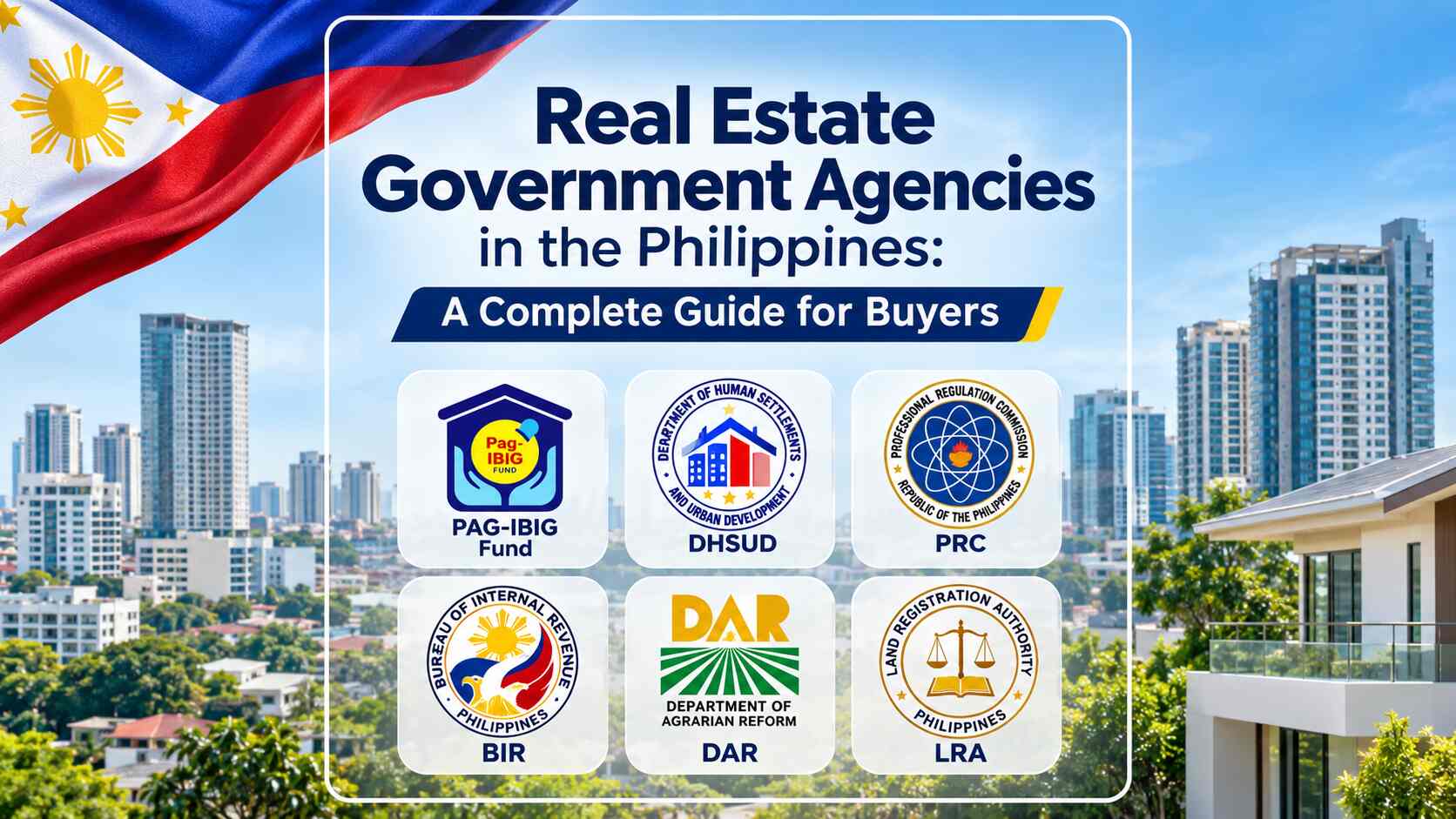

Buying a property in the Philippines involves more than choosing a location, checking the price, and signing a contract. Several government agencies help regulate real estate projects, verify property ownership, process taxes, and protect buyers.
Understanding what these agencies do can help you make informed decisions, avoid costly mistakes, and complete your property purchase with greater confidence.
This guide explains the major Philippine government agencies involved in real estate, their responsibilities, and how they affect your property purchase.
- DHSUD: Department of Human Settlements and Urban Development
- HSAC: Human Settlements Adjudication Commission
- PRC: Professional Regulation Commission
- AMLC: Anti-Money Laundering Council
- LRA: Land Registration Authority
- RD: Registry of Deeds
- BIR: Bureau of Internal Revenue
- LGU: Local Government Unit (Treasurer and Assessor)
- HDMF: Home Development Mutual Fund / Pag-IBIG Fund
- NHA: National Housing Authority
- SHFC: Social Housing Finance Corporation
- DENR: Department of Environment and Natural Resources
- DAR: Department of Agrarian Reform
- Buy a property with confidence
Here are some Real Estate Government Agencies in the Philippines:
DHSUD: Department of Human Settlements and Urban Development
The government agency responsible for housing and urban development, including regulating housing policies for subdivision and condominium projects.
Key Responsibilities:
- Certificate of Registration (CoR) & License to Sell (LTS): Issues mandatory registration certificates and Licenses to Sell to real estate developers before any subdivision or condominium project can be legally marketed or sold to the public.
A project without a valid LTS is legally barred from selling. Check this before paying any reservation fee. - Disputes: Receiving and addressing buyers’ complaints involving developers and housing projects.
- Housing Standards & Compliance: Setting housing development standards and monitoring compliance.
- Buyer Protection: Enforces Presidential Decree No. 957 (Subdivision and Condominium Buyers’ Protective Decree) and Batas Pambansa Blg. 220 (Socialized & Economic Housing Standards) to safeguard buyers against developer default, delayed completion, and unauthorized plan alterations
- Real Estate Broker Registration: Maintains regulatory oversight and registration for real estate service practitioners operating in residential projects.
- Homeowners Association (HOA) Management: Oversees the registration and regulation of HOAs across residential developments.
What Buyers Should Know
- Before buying: Ask the developer for the project’s Certificate of Registration and License to Sell. Verify their validity with the DHSUD Regional Office where the project is located.
- Check the License to Sell: Confirm that the license covers the specific project you’re buying, not merely the developer’s company registration or business permit.
- Verify the project details: Compare the project’s approved plans, location, and specifications with what the seller is offering.
- Review your contract: Check the total purchase price, payment terms, unit specifications, turnover date, and other obligations before signing the Contract to Sell.
- If a developer fails to comply: You may seek assistance from the DHSUD Regional Office. Certain disputes may also be filed with the Human Settlements Adjudication Commission (HSAC).
Important: A DHSUD License to Sell is a regulatory safeguard, not a guarantee of investment returns or a substitute for checking the property’s title and the developer’s obligations.
Official website: DHSUD
HSAC: Human Settlements Adjudication Commission
The Human Settlements Adjudication Commission (HSAC) is the adjudicatory body responsible for resolving certain disputes involving housing and real estate development.
Key Responsibilities
Enforce decisions: Issue orders and other legal remedies within its jurisdiction to ensure compliance with its decisions
Resolve buyer-developer disputes: Hear cases involving subdivision and condominium purchases, including claims for refunds, contract cancellation, and failure to fulfill contractual obligations.
Protect buyers’ rights: Address complaints involving delayed project completion, undelivered units, and violations of housing laws.
Handle homeowners’ association disputes: Resolve certain disputes involving HOA membership, governance, and rights of homeowners.
Review zoning appeals: Hear appeals from decisions of local and regional planning and zoning bodies.
What Buyers Should Know
- Before buying: Verify that the developer has the required Certificate of Registration and License to Sell from the DHSUD.
- Review your contract: Understand the payment terms, turnover date, unit specifications, and your rights if the developer fails to fulfill its obligations.
- If problems arise: You may file a complaint with the HSAC Regional Adjudication Branch that has jurisdiction over your case.
- Keep your records: Save your Contract to Sell, official receipts, payment records, correspondence, and other documents supporting your complaint.
- Know your rights: Depending on the circumstances, buyers may seek remedies such as contract cancellation, refunds, or an order requiring the developer to fulfill its obligations.
Important: HSAC handles disputes within its legal jurisdiction. Not every real estate complaint belongs before HSAC, so confirm the appropriate forum before filing.
Official website: HSAC
PRC: Professional Regulation Commission

Regulated under Republic Act No. 9646 (the Real Estate Service Act of 2009, or RESA Law), the PRC oversee professional standards in Philippine real estate.
Key Responsibilities:
- Administers licensure examinations and issues professional identification cards to Real Estate Brokers, Real Estate Appraisers, and Real Estate Consultants.
- Registers accredited Real Estate Salespersons supervised by licensed brokers.
- Enforces anti-colorum measures against illegal, unlicensed real estate practitioners.
What buyers should know
When working with a real estate broker or salesperson, verify their professional credentials.
A licensed real estate broker can provide professional brokerage services, while a salesperson must comply with the applicable accreditation and supervision requirements.

Ask for the practitioner’s PRC identification card or other applicable proof of accreditation.
This is especially important when purchasing a property online or dealing with someone you have never met in person.
Official website: PRC
AMLC: Anti-Money Laundering Council
AMLC is the central financial intelligence unit, law enforcement agency, and regulatory body of the Philippines tasked with preventing and fighting money laundering, terrorist financing, and proliferation financing.
Key Responsibilities:
- Monitor suspicious transactions: Receive and analyze reports of covered and suspicious transactions from regulated businesses and professionals.
- Investigate financial crimes: Investigate suspected money laundering and related financial activities.
- Enforce compliance: Require covered businesses and professionals to comply with anti-money laundering regulations.
- Protect the financial system: Help prevent the use of financial institutions and businesses to conceal illegally obtained funds. AMLC
What Buyers Should Know
- Before buying: Be prepared to provide valid identification and documents showing the source of your funds. Developers and brokers may need to conduct customer due diligence as part of their legal obligations.
- Large cash transactions: Real estate brokers and developers are covered persons under the Anti-Money Laundering Act. Cash transactions exceeding ₱7.5 million are subject to covered transaction reporting requirements.
- Suspicious transactions: A transaction may be reported regardless of amount if it appears suspicious under the law. A report does not automatically mean that the buyer has committed a crime.
- Buyer protection: AMLC compliance helps reduce the risk of real estate transactions being used to launder money or conceal illegal funds.
Important: The ₱7.5 million threshold applies to cash transactions, not the total purchase price of every property.
Official website: AMLC
LRA: Land Registration Authority
Operating as an attached agency of the Department of Justice (DOJ), the LRA manages the registration of land titles and deeds across the country through local Registry of Deeds (RD) offices nationwide.
Key Responsibilities:
- Title Issuance: Issues official ownership titles, specifically the Transfer Certificate of Title (TCT) for land/houses and the Condominium Certificate of Title (CCT) for condo units.
- Title Custody: Maintains the official public registry of land titles and records all legal encumbrances, liens, mortgages, adverse claims, or restrictions annotated on a property.
What buyers should know
- Before buying: Get a Certified True Copy of the title from the RD and compare it to the seller’s copy. It shows the registered owner, any mortgage, adverse claim, lis pendens, or other annotation.
- After buying: The RD registers the sale and issues your new title. Registry of Deeds processing usually takes one to four weeks.
- Registration fee: This follows a graduated LRA schedule and is typically around 0.25% of the property value, as cited by common buyer guides.
- Title formats: The LRA is also moving titles toward electronic (eTitle) formats, so ask the RD what applies in your area.
Official website: LRA
RD: Registry of Deeds
The Registry of Deeds (RD) is the local government office responsible for registering land ownership and real estate transactions. It maintains official records of property titles, deeds of sale, mortgages, and other documents affecting ownership or interests in real property. It operates under the Land Registration Authority (LRA).
Key Responsibilities
- Register property transfers: Register deeds of sale and other documents transferring ownership, and issue the corresponding new certificates of title.
- Maintain property records: Keep official records of registered land titles, ownership history, mortgages, and other registered interests.
- Issue certified true copies: Provide certified copies of titles and registered documents for property verification and other legal purposes.
- Record property encumbrances: Register mortgages, liens, and other instruments affecting a property’s ownership or legal status.
- Process title transactions: Handle registration, cancellation, transfer, and annotation of property titles in accordance with applicable laws.
What Buyers Should Know
- Before buying: Obtain a Certified True Copy (CTC) of the title from the RD and compare it with the seller’s copy. Check the registered owner, title number, and any mortgages, adverse claims, liens, or other annotations.
- Verify ownership history: Review the RD’s records for previous transfers and registered documents. Do not rely solely on the seller’s title, especially if there are suspicious circumstances.
- Before transferring ownership: Ensure the required documents and taxes are complete. The RD requires the BIR’s Certificate Authorizing Registration (CAR/eCAR), real property tax clearance, and proof of transfer tax payment for title issuance.
- After buying: The RD registers the sale and issues the new title in your name once the requirements are satisfied. Keep your owner’s duplicate title and registered deed of sale in a safe place.
- Processing time: Ask the specific RD about its current processing time. It varies depending on the transaction, completeness of documents, and whether the title is electronic or manually issued.
BIR: Bureau of Internal Revenue
The BIR is the national tax assessment and collection body under the Department of Finance (DOF).
Key Responsibilities:
- Property Tax Collection: Assesses and collects national internal revenue taxes on property transfers, including Capital Gains Tax (CGT), Documentary Stamp Tax (DST), Value Added Tax (VAT), and Creditable Withholding Tax (CWT).
- eCAR Issuance: Issues the electronic Certificate Authorizing Registration (eCAR) upon full payment of taxes.
What buyers should know
Before buying: Clarify who will pay the applicable transfer taxes and expenses before signing the Contract to Sell or Deed of Absolute Sale. Clearly state in the contract which party is responsible for each tax and transfer expense to avoid disputes.
Tax payment: The BIR issues an electronic Certificate Authorizing Registration (eCAR) after the required transfer taxes have been settled.
Title transfer: The Registry of Deeds requires an official eCAR before transferring the title to the buyer and issuing a new TCT or CCT.
| Tax | Typical rate | Usually paid by |
| Capital Gains Tax (CGT) | 6% of the highest of selling price, zonal value, or fair market value | Seller (by agreement) |
| Documentary Stamp Tax (DST) | 1.5% of the same base | Often the buyer, but negotiable |
| VAT or Withholding Tax | Applies in certain cases, such as sales by real estate dealers or developers | Depends on the seller |
Important: The BIR computes value as the higher of your selling price or the BIR zonal value. Declaring a lower price won’t reduce your taxes. Check the zonal value for your location before negotiating.
Official website: BIR
LGU: Local Government Unit (Treasurer and Assessor)
Your city or municipal hall handles two separate offices.

Treasurer’s Office
Collects the annual Real Property Tax (RPT) (commonly referred to as amortization or amilyar) and the local Transfer Tax. Issues the Tax Clearance Certificate verifying no delinquent property taxes exist.
- Transfer tax: Typically 0.5% in provinces and up to 0.75% in Metro Manila and some highly urbanized cities.
- Tax clearance: Confirms there are no unpaid real property taxes.
- Real Property Tax (RPT): An annual tax, generally 1% in provinces and up to 2% in cities and Metro Manila, based on assessed value. It may carry an additional 1% Special Education Fund (SEF).
Assessor’s Office
- Issues the Tax Declaration (TD) for land and improvements (buildings/structures) and assigns the property’s assessed value for local taxation.
The Registry of Deeds needs three clearances before registering the transfer: the BIR CAR, the transfer tax clearance from the local treasurer, and the real property tax clearance.
What buyers should know
Buyers must verify that the seller’s Tax Declaration details match the physical boundary measurements on the title and ensure that annual RPT payments are up to date via a Tax Clearance prior to closing.
HDMF: Home Development Mutual Fund / Pag-IBIG Fund
Home Development Mutual Fund, also known as the Pag-IBIG Fund (Pag-tutulungan sa Kinabukasan Ikaw, Bangko, Industriya, at Gobyerno).
Pag-IBIG Fund is the primary government provident fund offering accessible home financing to Filipino workers and qualified foreign-earned overseas workers.
Key Responsibilities:
- Provides long-term residential housing loans (up to 30 years) for property acquisition, lot purchase, construction, and home improvements.
- Administers socialized housing finance schemes for low- and middle-income earners.
If you plan to use Pag-IBIG financing, check whether the property and developer are eligible for the intended loan program.
For pre-selling properties, ask the developer when the project will be eligible for Pag-IBIG takeout and what requirements must be completed before loan processing.
Official website: Pag-IBIG Fund
NHA: National Housing Authority
NHA is the primary government agency in the Philippines responsible for public and socialized housing, resettlement programs, and disaster-related shelter assistance for low-income, marginalized, and homeless families.
Key Responsibilities
- Develop affordable housing: Build and provide housing units for qualified low-income and underprivileged families.
- Implement resettlement programs: Relocate families affected by government infrastructure projects, court-ordered evictions, or those living in danger zones.
- Develop housing communities: Provide housing projects with basic services and community facilities.
- Manage government housing projects: Administer housing units, beneficiary selection, and the disposition of government housing assets.
- Support disaster recovery: Provide emergency and post-disaster housing assistance to displaced families.
What Buyers Should Know
- Before buying: If purchasing an NHA housing unit, verify that the seller is the registered beneficiary or authorized owner and has the legal right to sell or transfer the property.
- Check title restrictions: Some NHA properties have restrictions on resale, transfer, or ownership. Review the title and applicable NHA rules before proceeding.
- Verify transfer requirements: Ask the NHA or Registry of Deeds about the documents and approvals needed to transfer the property and obtain a new title.
- Understand eligibility: NHA housing projects are generally intended for qualified beneficiaries, particularly low-income families. Not all projects are open to the general public.
- Buyer protection: Verify the property’s ownership, transfer eligibility, and any outstanding obligations before paying a reservation fee or signing a contract.
Official website: NHA
SHFC: Social Housing Finance Corporation
SHFC is a government agency tasked with developing and implementing affordable housing solutions for Filipino families.
Key Responsibilities:
- Flagship Housing: Leads the implementation of the Expanded Pambansang Pabahay para sa Pilipino (4PH) Program.
- Community Financing: Manages the Community Mortgage Program (CMP), Enhanced Community Mortgage Program (ECMP), and High-Density Housing (HDH) to help informal settler families (ISFs) and low-income formal and informal sectors acquire land and housing.
- Special Projects: Handles resettlement projects linked to infrastructure initiatives like the North-South Commuter Railway Extension (NSCR-Ex) and the Marawi Shelter Project.
Headquarters: BDO Plaza, 8737 Paseo de Roxas, Makati City, Metro Manila
Official website: SHFC
DENR: Department of Environment and Natural Resources
The Department of Environment and Natural Resources (DENR) is responsible for environmental protection and the management of the country’s natural resources.
Key Responsibilities
- Manage public lands: Oversee the administration, classification, and disposition of lands belonging to the public domain.
- Verify land classification: Determine whether public land is classified as agricultural, forest, mineral, or protected land.
- Process land applications: Handle applications for certain public land grants, patents, and leases.
- Protect the environment: Regulate activities affecting forests, watersheds, wildlife, and protected areas.
- Provide land records and surveys: Facilitate access to land classification information, survey verification, and other land-related records.
What Buyers Should Know
Buyer protection: A DENR certification alone does not guarantee ownership or a valid title. Confirm the property’s legal status and registration with the appropriate agencies before paying or signing a contract.
Before buying: Verify the property’s title with the Registry of Deeds. For untitled land or land originally granted by the government, check with the DENR whether the property is eligible for private ownership.
Check land classification: Confirm whether the property is within an alienable and disposable (A&D) area. Forestlands and other inalienable public lands generally cannot be privately owned. Lawphil+1
Verify boundaries: For vacant lots or large parcels, have a licensed geodetic engineer verify the property’s boundaries and survey plan. The DENR can provide relevant land classification and survey records.
Check environmental restrictions: Properties near forests, coastlines, watersheds, or protected areas may be subject to additional restrictions or permit requirements. Verify these before purchasing or developing the property.
Official website: DENR
DAR: Department of Agrarian Reform
The Department of Agrarian Reform (DAR) administers agrarian reform laws and policies involving agricultural land.
Key Responsibilities:
Land Redistribution: Implements the Comprehensive Agrarian Reform Program (CARP) under Republic Acts No. 6657 and 9700.
Tenurial Security: Issues Certificates of Land Ownership Award (CLOA) to qualified landless farmer-beneficiaries.
Agrarian Justice: Resolves land disputes and provides legal assistance through the Bureau of Agrarian Reform Legal Assistance and the DAR Adjudication Board.
Support Services: Coordinates farm-to-market roads, irrigation, credit, and cooperative development to help farmers improve productivity.
What buyers should know
If you plan to purchase agricultural land or a property that was previously classified as agricultural land, verify whether the property is subject to agrarian reform restrictions.
Depending on the circumstances, land conversion or exemption clearances may be required before the property can be used for residential or commercial development.
Buying farmland? Ask whether the land is covered by CARP, whether it carries a CLOA or EP, and whether there are tenants or farmer-beneficiaries.
Do not assume that agricultural land can automatically be converted into a residential subdivision or commercial property.
If you plan to use agricultural land for residential or commercial purposes, you will usually need a DAR land use conversion clearance.
Official website: DAR
To recap, here is the quick Real Estate Agencies checklist:
| Agency | What buyers should check |
|---|---|
| DHSUD | ☐ Verify the project’s Certificate of Registration and License to Sell. |
| HSAC | ☐ Know where to file a complaint if a developer violates your contract or buyer rights. |
| PRC | ☐ Verify that your real estate broker or salesperson is properly licensed or accredited. |
| AMLC | ☐ Prepare valid identification and documents showing the source of funds, if requested. |
| LRA / Registry of Deeds | ☐ Obtain a Certified True Copy of the title. Check ownership, mortgages, liens, and other annotations. |
| BIR | ☐ Confirm applicable taxes, who will pay them, and the required eCAR for title transfer. |
| LGU | ☐ Check zoning, building permits, real property tax status, and any local restrictions. |
| Pag-IBIG Fund / HDMF | ☐ Confirm housing loan eligibility, financing terms, and required documents if using a Pag-IBIG loan. |
| NHA | ☐ Verify ownership, transfer eligibility, and any resale restrictions for NHA housing units. |
| SHFC | ☐ Confirm eligibility, payment obligations, and transfer rules for community mortgage or socialized housing projects. |
| DENR | ☐ Verify land classification, environmental restrictions, and survey information where applicable. |
| DAR | ☐ Check for agricultural land restrictions, agrarian reform coverage, or required DAR clearance. |
Buy a property with confidence
Buying a property is a major financial decision. Knowing which government agencies are involved can help you verify important documents, understand your obligations, and avoid common mistakes.
Before purchasing, remember to:
- Verify the developer and real estate professional.
- Check the project’s required registration and license.
- Review the title and property records.
- Understand all taxes, fees, and payment terms.
- Confirm the property’s intended use and any applicable restrictions.
At yourhome.ph, we help buyers understand the property market and make informed real estate decisions.
Whether you are buying your first home, investing in a condominium, or exploring commercial property opportunities, the right information can make the buying process clearer and more manageable.
Ready to find your next property? Explore our available properties at yourhome.ph and let us help you find a property that fits your needs and budget.




Tags